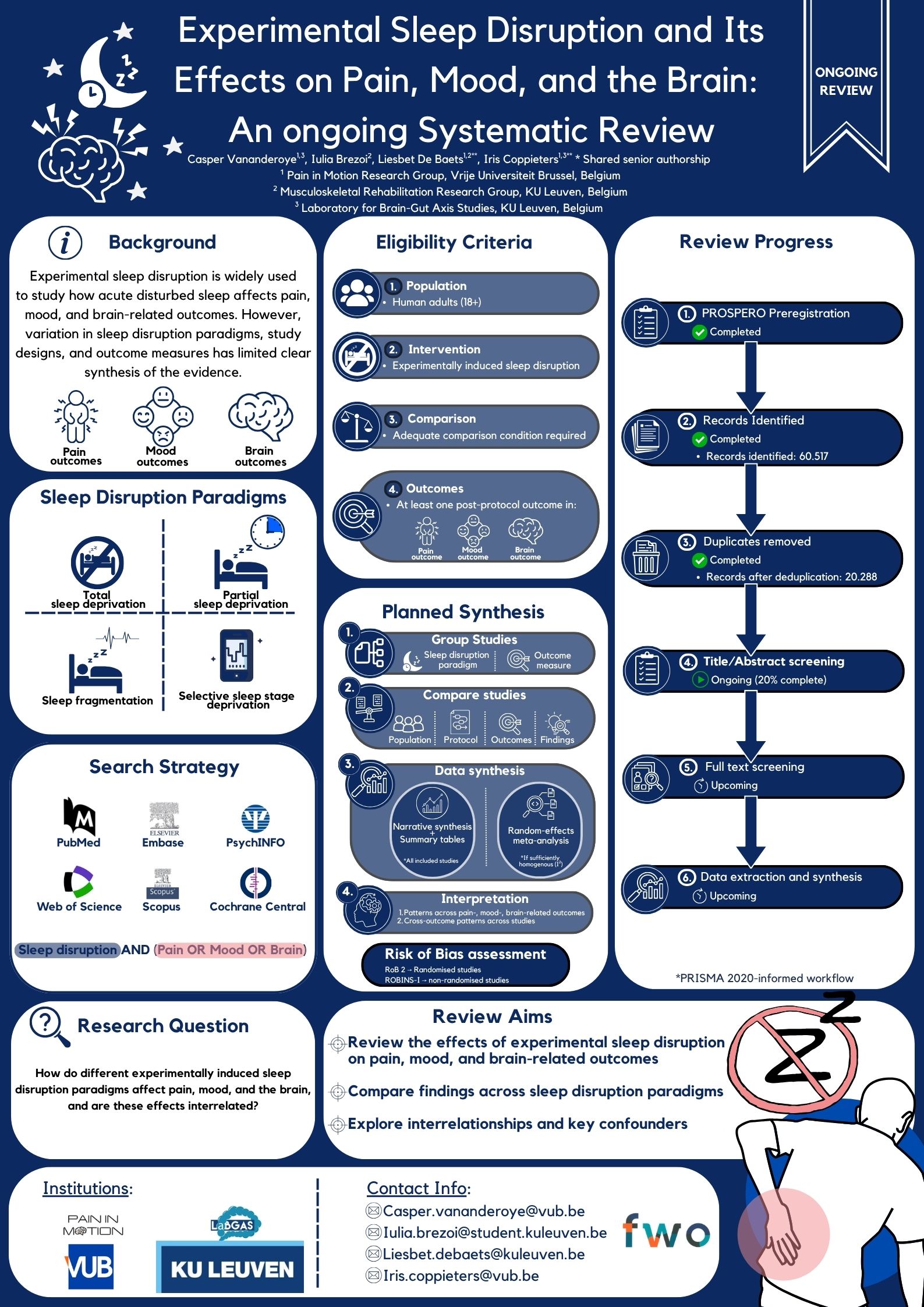
A bad night of sleep can leave us feeling more irritable, less focused, and sometimes even more sensitive to pain. But what happens to pain, mood and the brain when sleep is deliberately disrupted? At Pain Science in Motion 2026, I presented our ongoing systematic review on the effects of experimental sleep disruption on these outcomes.
Sleep can be disrupted in different ways. Some studies keep participants awake for an entire night, while others reduce sleep duration, repeatedly interrupt sleep, or selectively disturb specific sleep stages. These different approaches allow researchers to investigate how sleep loss or disturbed sleep affects the body and brain under controlled conditions. Our review therefore considers several experimental sleep disruption paradigms rather than treating all disturbed sleep as the same phenomenon.
This is particularly relevant for pain research. Sleep problems are common in people with chronic pain, and previous research suggests that disrupted sleep can increase pain sensitivity. At the same time, sleep disruption can influence mood and brain functioning, which may in turn interact with how pain is experienced. By bringing together findings across pain-, mood-, and brain-related outcomes, we hope to better understand the broader consequences of experimentally disturbed sleep and whether certain types of sleep disruption produce different effects.
Ultimately, a clearer understanding of these relationships may help explain why sleep is such an important factor in both physical and psychological health, and why it deserves particular attention in people living with persistent pain.
Casper Vananderoye
PhD student, Pain in Motion Research Group – Vrije Universiteit Brussel, Laboratory for Brain-Gut Axis Studies – KU Leuven
2026Pain in Motion
References and further reading:
1. Chang, J. R., Fu, S.-N., Li, X., Li, S. X., Wang, X., Zhou, Z., Pinto, S. M., Samartzis, D., Karppinen, J., & Wong, A. Y. L. (2022). The differential effects of sleep deprivation on pain perception in individuals with or without chronic pain: A systematic review and meta-analysis. Sleep Medicine Reviews, 66, 101695. https://doi.org/10.1016/j.smrv.2022.101695
2. Palmer, C. A., Bower, J. L., Cho, K. W., Clementi, M. A., Lau, S., Oosterhoff, B., & Alfano, C. A. (2024). Sleep loss and emotion: A systematic review and meta-analysis of over 50 years of experimental research. Psychological Bulletin, 150(4), 440–463. https://doi.org/10.1037/bul0000410
3. Reimann, G. M., Hoseini, A., Koçak, M., Beste, M., Küppers, V., Rosenzweig, I., Elmenhorst, D., Pires, G. N., Laird, A. R., Fox, P. T., Spiegelhalder, K., Reetz, K., Eickhoff, S. B., Müller, V. I., & Tahmasian, M. (2025). Distinct convergent brain alterations in sleep disorders and sleep deprivation: A meta-analysis. JAMA Psychiatry, 82(7), 681–691. https://doi.org/10.1001/jamapsychiatry.2025.0488